
A bowl of rice takes about 15 minutes to cook. The grain inside it took months to grow. Most rice varieties, including aromatic jasmine rice, need roughly four months in the field — and in organic farming, every one of those weeks depends on patience, good timing and a close relationship with the land.
Here is what a rice season looks like, step by step.
1. Preparing the soil
Everything begins in the soil. Before planting, the field is plowed to loosen the earth and leveled carefully so water will spread evenly across it later. In organic farming, the soil is fed naturally — with compost, animal manure and green manure crops that are grown and then turned back into the earth. Instead of synthetic fertilizers, the goal is to build living soil that stays fertile season after season.
2. Raising the seedlings
Good rice starts with good seed. Farmers choose healthy, well-filled seeds and often soak them so they begin to sprout. The young plants are raised in a small, protected nursery bed, where they can be watched closely during their most delicate weeks.
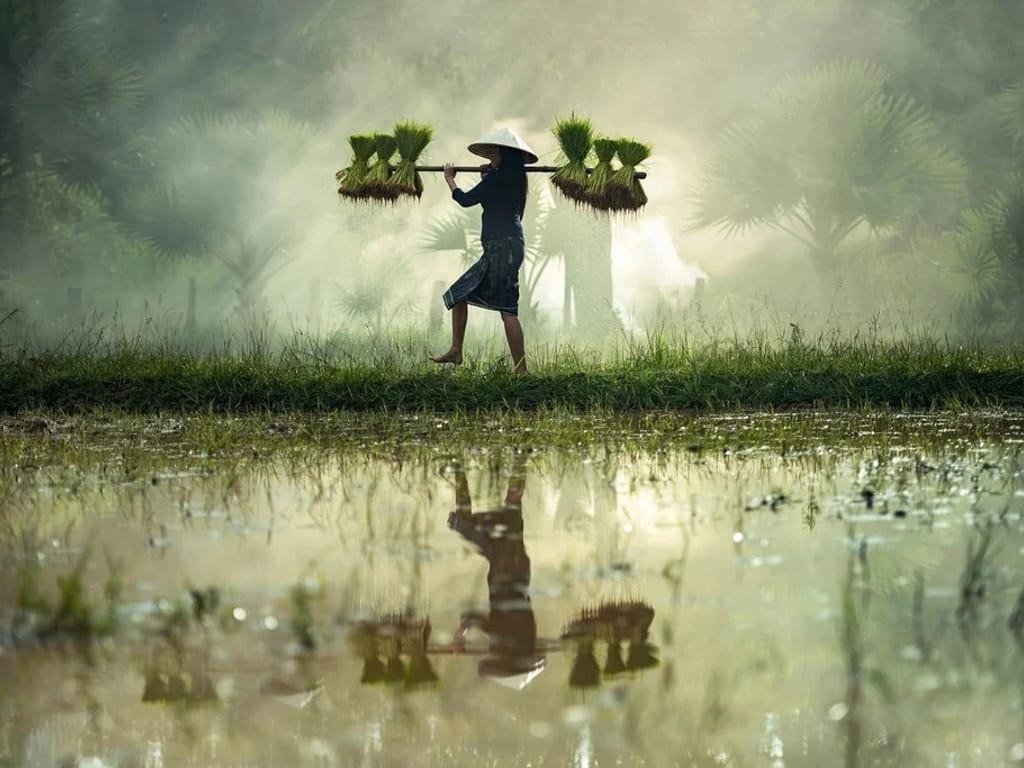
After about three to four weeks, the seedlings are bright green and around a hand’s length tall. They are gently pulled, tied into bundles and carried out to the flooded field — one of the most beautiful sights of the rice year.
3. Transplanting
Seedlings are planted into the soft, wet mud in neat rows, with enough space between them for each plant to grow strong. Some farms transplant by hand, others with small machines; some sow seed directly into the field instead. Either way, spacing matters: plants that have room to breathe get more sunlight and suffer less from disease.
4. Growing strong: tillering and water
In the weeks after transplanting, each seedling sends up new shoots, called tillers. One small plant can become a whole clump of stems, and each healthy tiller can later carry a head of grain.
Water is the farmer’s most important tool during this stage. A shallow layer of water in the field helps keep weeds down and protects the young plants. Many farms today also let fields dry briefly between floodings — a practice that saves water and encourages deeper roots.
5. Protecting the crop, the natural way
Organic rice farmers cannot reach for synthetic pesticides, so they work with nature instead. Healthy fields are home to spiders, dragonflies, frogs and birds that feed on pests. Strong varieties, good spacing, crop rotation and careful water management all help prevent problems before they start. Weeds are managed by water, by hand and with simple tools.
It is slower work than spraying a field — but it protects the soil, the water and the people who live and work nearby.
6. Flowering
About two months into the season, the plants begin to form a young grain head, called a panicle, deep inside the stem. A few weeks later it emerges and the rice flowers. Rice flowers are tiny and open for only a short time, usually in the morning. Each flower pollinates itself, and each successful flower will become a single grain of rice.
7. Ripening
After flowering, the grains slowly fill. They begin soft and milky, then thicken to a dough-like texture, and finally harden as they mature. Over these weeks the field changes color from deep green to gold, and the heavy heads of grain begin to bow.
Toward the end, the field is drained so the soil can dry before harvest.
8. Harvest: timing is everything
Harvest comes when most of the grains on each head have turned golden and firm. Picking too early leaves grains that are immature and chalky; waiting too long means grains that crack during milling or fall to the ground. That is why we harvest our rice at the right ripeness — it protects both the flavor and the quality of every grain.
9. Drying and milling
Freshly harvested rice still holds a lot of moisture, so it is dried carefully until it is ready to store. Then it is milled. The first step removes the husk, leaving whole-grain rice — this is how purple rice and brown rice are kept. For white rice, a second step gently polishes away the bran and germ.
Gentle, modern milling helps preserve the grain’s natural nutrition, aroma and color, so the rice in your package tastes the way it did in the field.
Soil, seed, water, sun and patience — a season of rice is a partnership between farmers and nature.
The next time you lift the lid on a pot of O’GAO rice, we hope you think of the season behind it: the green seedlings, the flooded fields, the golden harvest — and the care that went into every grain.